July 4, 2026
Is money actually needed for a better life?
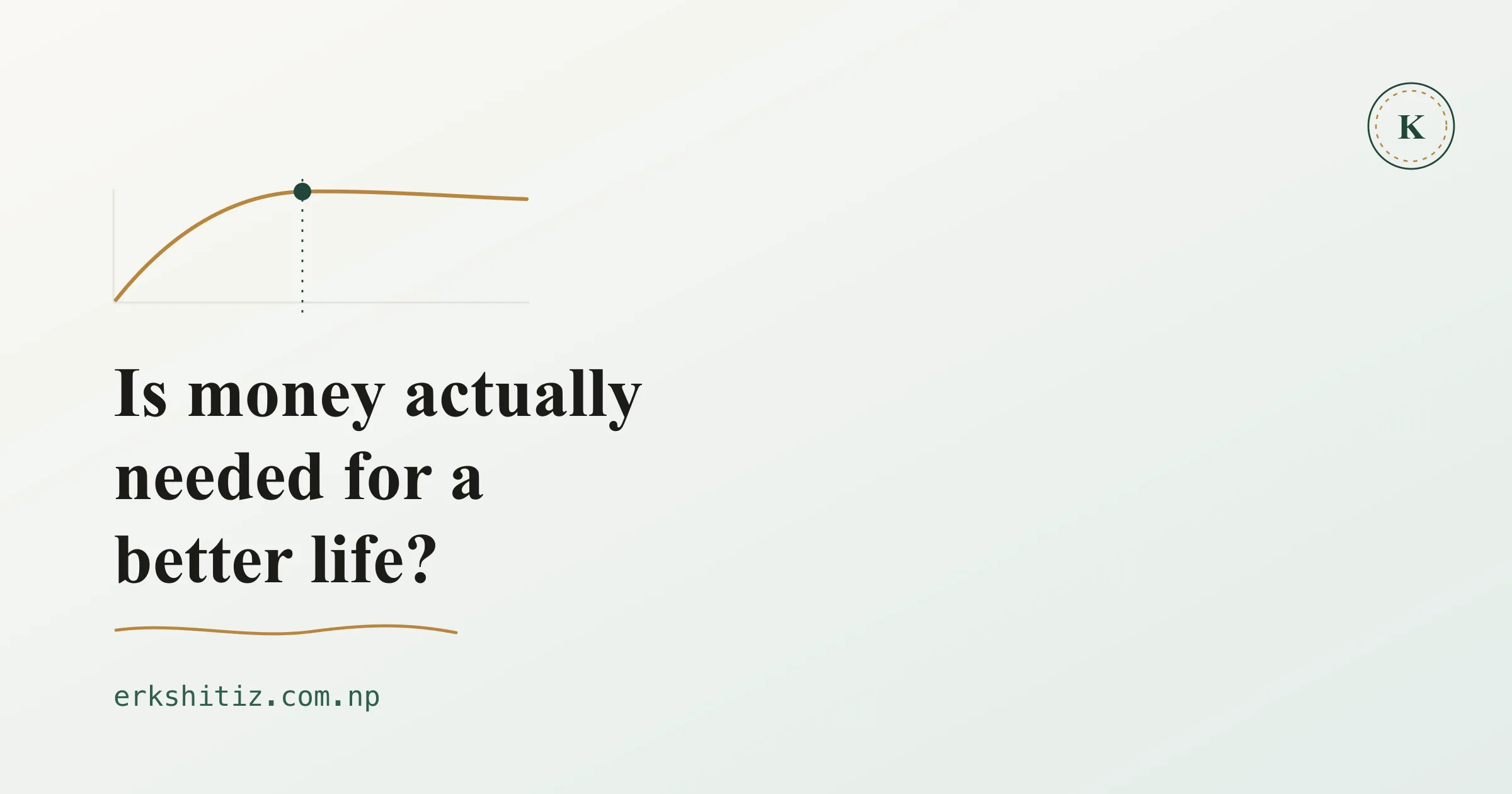
I want to answer this from actual numbers on actual paychecks rather than the usual “money can’t buy happiness” line, because that line is true in a way that is too vague to be useful. It tells you nothing about which parts of your life money will fix and which parts it will not touch no matter how much of it you have. I have gone from a junior PHP job in Kathmandu, to a remote US contract, to a senior role in Nepal working for a company based in Tokyo, and the pay changed by a large multiple at each step. So did my sense of what money was actually doing for me.
What money fixed, specifically
Early on, more money fixed real things I could point to. Rent stopped being a monthly source of dread. A medical bill did not mean renegotiating the rest of the month. I could turn down a client or a task I did not want to do without doing the mental math on whether I could afford to say no. None of that is abstract. Each of those is a specific kind of stress that goes away when there is a cushion under you, and I do not think anyone who has lived without that cushion would call it a small thing.
That is the part of “money helps” that is true and undersold by people who already have enough of it. Scarcity is not a mood, it is a constant low-grade tax on your attention. Every financial decision takes longer and costs more energy when you are close to the edge, because you are also tracking what happens if you are wrong. Removing that tax was the single best thing more money did for me, and it happened almost entirely in the first jump, not the later ones.
The point where it stopped fixing anything new
The second and third jumps in pay did not remove a new category of stress the way the first one did, because that category was already gone. What they mostly did was raise the ceiling on things I was not actually short on: a nicer version of something I already owned, more choice on a menu I was not unhappy with before. I noticed I was still checking the number going up and feeling something from it, but I could not point to a specific problem in my life that number had just solved. That gap, between the number going up and an actual problem going away, is where I think most of the “money can’t buy happiness” advice is quietly pointing without saying it directly.
I do not think this means the extra money was wasted. Savings, a safety margin, options for family, all real. But I had stopped being able to describe what a better life meant in terms that more salary would answer, and I kept optimizing for it anyway because it was the number I already knew how to move.
What actually moved the needle after that
The things that changed how good a given week felt, once the scarcity problem was gone, were not denominated in money at all. Work that involved solving a problem I actually cared about instead of one assigned to me moved it. Having enough control over my schedule to not be interrupted for four hours in a row moved it. Sleeping enough moved it more than any of the above. None of these are things a bigger paycheck buys directly, and a couple of them, the schedule control especially, got harder to protect as the roles got bigger and came with more meetings and more people depending on my availability.
That is the part that a purely money-focused view of career progress misses. Chasing the next title or the next pay band can quietly cost you the exact things that were actually making life better, and you do not notice the trade until you are a year into a role that pays more and somehow has less room in it.
The trap is using money as a stand-in for a different problem
The times I have chased more money past the point it was fixing anything were, looking back, usually about something else wearing a financial costume. Wanting to feel like I had “made it” compared to people I graduated with. Wanting some kind of proof, mostly to myself, that the last hard year was worth something. Money is a very legible way to keep score, which makes it an easy stand-in for problems that have nothing to do with a bank balance and everything to do with comparison or fear or needing external proof of progress. It never actually resolves those, because the thing being solved for was never really about money in the first place.
Where I’ve landed
Money is necessary for a better life up to a specific, identifiable point: the point where it stops being a source of daily stress and starts being background. Below that point, more of it is close to the highest-leverage thing you can add to your life, and I would not tell anyone in that position to deprioritize it. Above that point, it is just one input among several, and it is usually not the one that is actually limiting how good your life feels. Time, health, autonomy over your own schedule, and work you do not have to talk yourself into caring about, do more from there. The mistake I kept making was continuing to optimize the input I already had enough of, mostly because it was the easiest one to measure, while the ones that were actually short stayed short.